


Returning an Endangered Mussel to Yellowleaf Creek
Oct. 05, 2026
Conservation Efforts at Yellowleaf Mitigation Bank in Alabama
In September 2026, 300 endangered Coosa moccasinshell mussels (Medionidus parvulus) were introduced into a section of Yellowleaf Creek at Westervelt Ecological Services’s (WES) Yellowleaf Mitigation Bank in Shelby County, Alabama. The release continues the reintroduction efforts that began in 2022, supporting a species that had not been seen in Alabama since the 1970s.
WES is collaborating on the ongoing reintroduction effort with the Alabama Aquatic Biodiversity Center (AABC), Alabama Department of Conservation and Natural Resources, Georgia Department of Natural Resources, and U.S. Fish and Wildlife Service. Together, WES along with our parters have been able to support propagation efforts, annual releases, and long-term monitoring designed to better understand how the species is responding over time.
About the Mussel
The Coosa moccasinshell has been federally listed as endangered since 1993. Like other species of freshwater mussels, they are facing threats from habitat loss, pollution, and increased stream sediment. Freshwater mussels play an important role in maintaining water quality by filtering algae and bacteria from streams. However, they are sensitive to pollutants and habitat changes. Because of this sensitivity, their recovery can serve as an indicator of improving stream conditions.
Reintroduction at Yellowleaf
Yellowleaf Creek was selected as a reintroduction site following habitat assessments and mussel surveys conducted in 2022. The site was WES’ first commercial stream and wetland mitigation project in the Southeast and one of the first stream mitigation banks in Alabama. WES restored and enhanced close to 8 miles of streams throughout the site, which feed into Yellowleaf Creek. Surveys of the site showed a diverse aquatic community, including several other protected mussel species, making it an ideal candidate for Coosa moccasinshell reintroduction efforts.
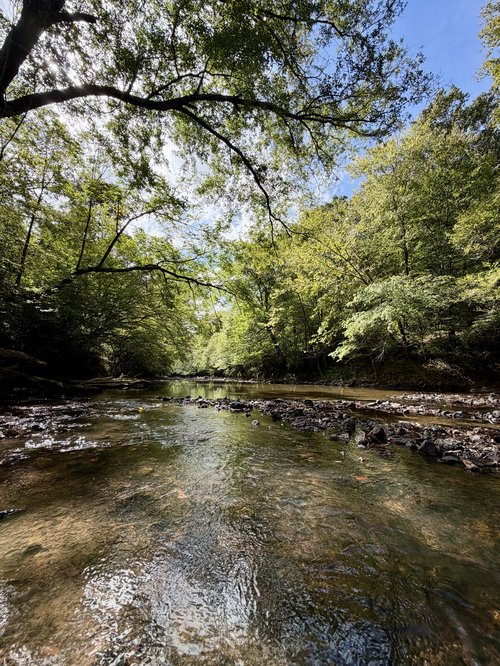
A view of aquatic habitat at Yellowleaf Mitigation Bank
Monitoring Mussels Over Time
During the first mussel release in 2022, the team reintroduced approximately 200 individuals onto the site. Each mussel receives a small, numbered tag attached to its shell so it can be identified and remeasured during future surveys. Tag colors change annually, making it easier to distinguish between release cohorts. A subset of mussels also receives passive integrated transponder (PIT) tags, which can be detected using an underwater scanner.
Annual monitoring is a key part of the reintroduction process. It allows biologists from AABC, the U.S. Fish and Wildlife Service, and WES to track mussels from previous releases and evaluate their progress over time. During surveys, biologists snorkel portions of Yellowleaf Creek to locate mussels visually and use PIT tag scanners to help find tagged individuals. When a previously released mussel is recaptured, it is measured again to document growth. Together, these surveys provide valuable information about mussels from previous releases and their successful establishment in Yellowleaf Creek. The mussels take three to five years to reach reproductive maturity, so ongoing release efforts are critical to establishing a self-sustaining population.
Monitoring efforts conducted in 2024 and 2025 successfully relocated tagged mussels from previous release cohorts, providing valuable information about their persistence in Yellowleaf Creek.
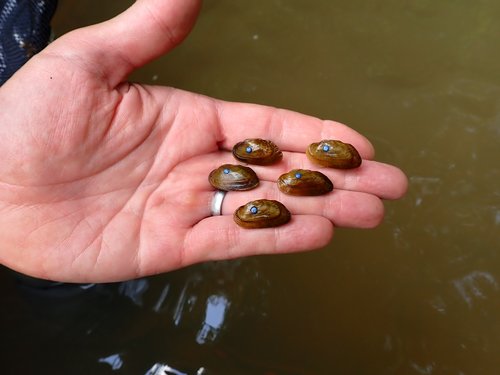
Numbered and color-coded tags allow biologists to identify mussels during future monitoring.
“The Coosa moccasinshell project is a great example of what can happen when restoration strong partnerships come together. At WES, we’re always looking for innovative ways to move conservation forward. We saw an opportunity to reintroduce mussels to our banks and found great partners to help us do so. Seeing a species once believed to be gone from Alabama successfully reintroduced into Yellowleaf Creek has been incredibly rewarding.” -Seth Hunt, Restoration Ecologist
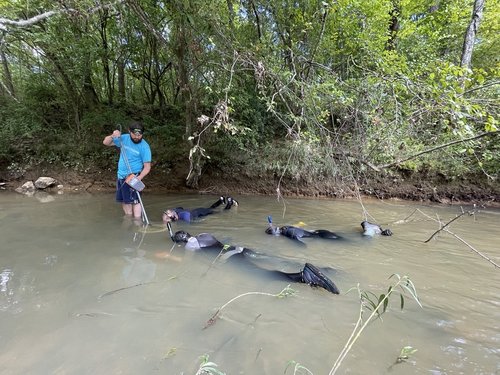
2025: Biologists survey Yellowleaf Creek for mussels released during previous years.
Looking Ahead at Yellowleaf
The September 2026 release marks the latest chapter in a multi-year conservation effort that began with habitat assessments in 2022. Each year, partners return to Yellowleaf Creek to monitor previously released mussels, gather new data, and continue reintroduction efforts.
As monitoring continues, WES and its partners are building a deeper understanding of how reintroduced Coosa moccasinshell populations respond while helping return an endangered species to part of its historic Alabama range.
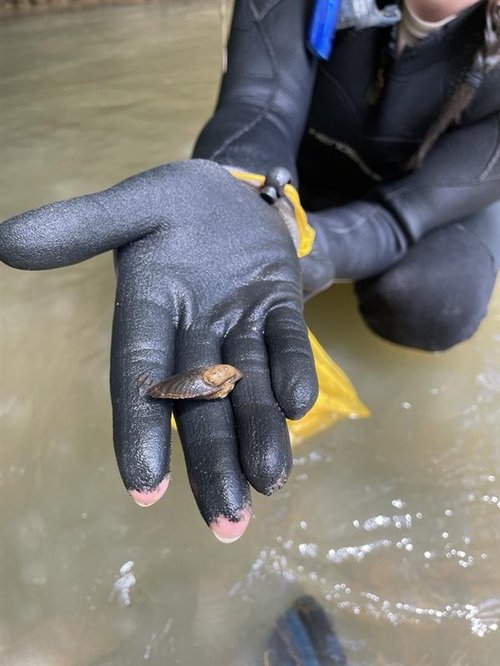
A freshwater mussel located during monitoring at Yellowleaf Mitigation Bank.
Share this news:


