


Newsletter
Rebuilding Reefs
A New Oyster Restoration Project in South Carolina
Jun. 19, 2025 | Cole Cook, Biologist
WES is thrilled to announce a new partnership with the Seabrook Island Property Owners Association (SIPOA) and Sea Island Club (SIC) to restore oyster reefs in Charleston, South Carolina. This project aims to mitigate unintended impacts on the salt marsh at the Seabrook Island golf course while restoring local habitats.
Why Oysters?
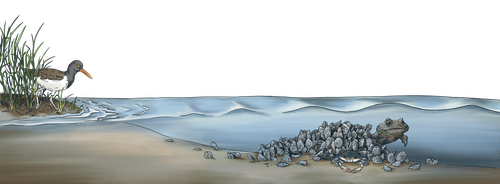
Oyster reefs play a crucial role in maintaining healthy coastal ecosystems. They provide benefits including water filtration, habitat creation, and shoreline protection. Oysters grow in clusters on old shells, rock, or any hard submerged surface. After spawning and fertilization, baby oysters, known as larvae, are free-swimming (planktonic). Towards the end of its planktonic larval cycle, oyster larvae develop a “foot” and settle to the bottom of the water column. Eventually, successful larvae find their way to existing oyster reefs or other hard structures to attach. The newly attached oyster, known as “spat”, grows from here until adulthood.
Once established, oyster reefs provide habitat for a variety of marine species, including fish, crabs, and other invertebrates. Additionally, established oyster reefs provide natural shoreline protection, reducing the impact of waves and preventing shoreline erosion.
Reef Restoration
Oyster reefs are re-established by installing bare shell to create substrates for new oysters to attach. WES plans to construct oyster reefs by transporting bare shells on a barge, at high tide, and evenly distributing the shells over the selected footprint. To cover a half acre site with 3-4 inches of oyster shell, WES is going to need 5,000 bushels of oyster shells installed. Due to the scarcity of local bare oyster shells at this scale, WES Charleston has collaborated with our team in Auburn to locate oyster shells from Bon Secour, Alabama.
Currently, WES is drafting the Oyster Restoration Plan, evaluating potential sites, and working with local contractors to bring oyster shell from Bon Secour to Charleston. Once a site is chosen, federal and state permits will be acquired to place the shell in tidal waters. To ensure the project’s success, the WES team will monitor the site for a minimum of three years following construction.
This is the first time the WES team has implemented an oyster reef restoration project and we are all excited for this new opportunity to do impactful restoration. This initiative not only addresses the decline of oyster populations but also fosters a healthier marine environment for future generations.
Share this news:


